The Red Alert Thirty-One People Watched
Tessa’s control tower saw the disruption eleven days before it hit. Thirty-one people opened the alert. Nobody moved. This is the story of how she taught her tower a verb.
The wall she was proud of
Tessa built the control tower herself. Eleven screens across the far wall of the planning floor at a mid-size snack-foods maker, every one of them alive: supplier risk scores, carrier ETAs, port dwell times, storm cells drifting across the Gulf, point-of-sale feeds refreshing every fifteen minutes. Visitors stopped in the doorway. The CEO walked the board through it twice.
She had spent nine years in planning before that, most of them flying blind — learning about a late container when the DC called, learning about a supplier fire from the trade press. The wall was her answer to every one of those mornings. Nothing would surprise them again.
It fired about 2,300 alerts a week. Tessa took that as proof it was working.
The tile that stayed red for six days
In early August, a risk feed flagged a fire at the plant that printed the film for her company’s best-selling multipack. The tile went red on a Wednesday. Severity: high. Impact window: eleven days.
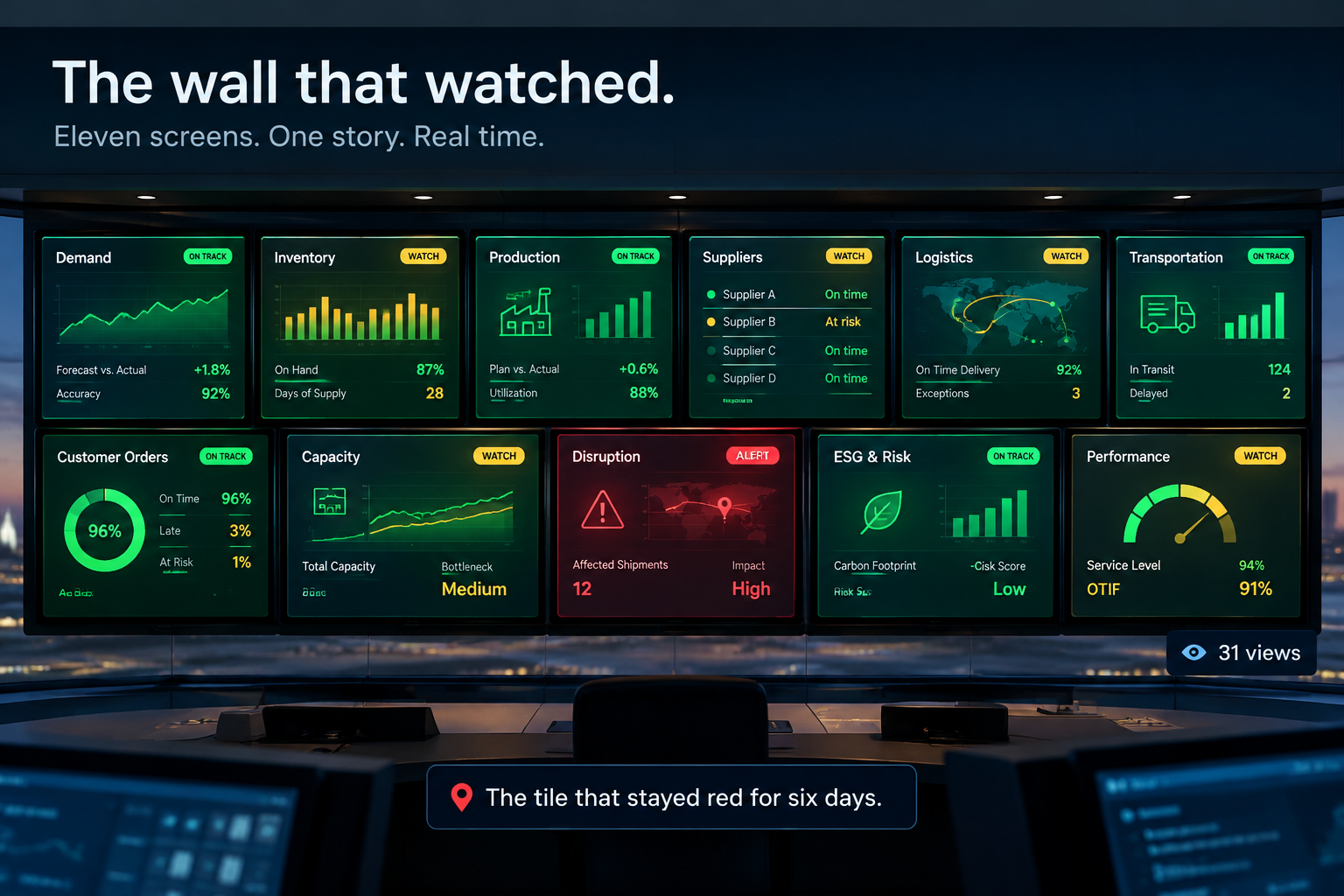
Then nothing happened. Procurement assumed planning had it. Planning assumed procurement was calling the supplier. The plant manager saw it, decided it was a corporate problem, and went back to a line changeover. The tile made Monday’s ops deck as slide fourteen: Watch item. The system logs later showed that thirty-one people had opened it.
On day eleven, film deliveries stopped. The multipack went short for eighteen days in the middle of back-to-school, with a national retailer’s promotion already locked. Lost sales, retailer fines and a panic spot-buy of film at triple the price came to roughly $2.4 million.
The post-mortem was the worst meeting of Tessa’s career, and nobody even raised their voice. It was one line on the timeline slide that did it. We didn’t miss it. We watched it.
Thirty-one viewers, zero owners
We have sat in a version of that post-mortem more times than we want to count, and the instinct in the room is always the same: we need better visibility. More signals, faster feeds, a sharper risk score. Tessa’s instinct was the same for about a week.
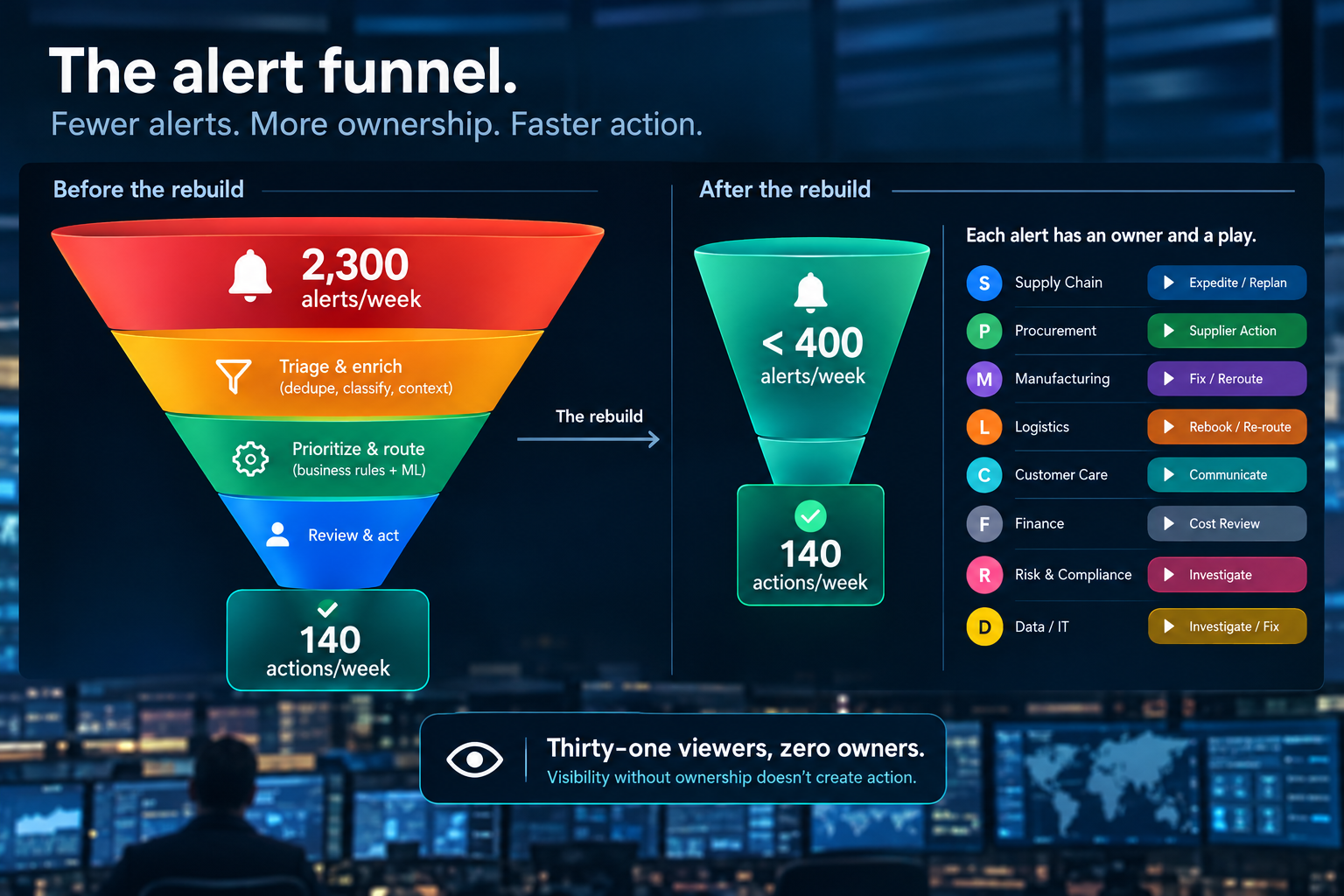
Then she pulled the numbers on her own wall. Of the 2,300 alerts it fired in a typical week, about 140 led anyone to do anything. The rest were seen, acknowledged and left to age out. Her team wasn’t lazy. They were deaf, and the wall had trained them to be.
Hospitals learned this first. When the Joint Commission issued its Sentinel Event Alert on medical-device alarms in April 2013, it estimated that 85 to 99 percent of alarm signals need no clinical intervention, and it named alarm fatigue the most common contributing factor in alarm-related sentinel events. The nurses weren’t careless. They had learned, rationally, that the beep usually meant nothing.
The retail version is worse, because noise wasn’t the problem. In 2013 Target had spent $1.6 million on FireEye malware detection and staffed a team in Bangalore to watch it around the clock. When attackers got into the payment system before Thanksgiving, the tool caught them and raised alerts at the top of its severity scale, and Bangalore passed them to the security center in Minneapolis. Nobody acted. According to people who audited the system afterward, it could have removed the malware on its own — but that function had been switched off. Bloomberg Businessweek’s March 2014 reconstruction is the cleanest case I know of a company that sensed perfectly and acted not at all.
That was Tessa’s reframe, and I would hang it on every control tower I have walked through:
A signal nobody is obligated to act on isn’t intelligence. It’s a better view of the fire.
Her wall had nouns everywhere — risk, ETA, dwell, score. What it never had was a verb.
Teaching the wall a verb
The rebuild took five months, and the first thing she did was turn screens off.
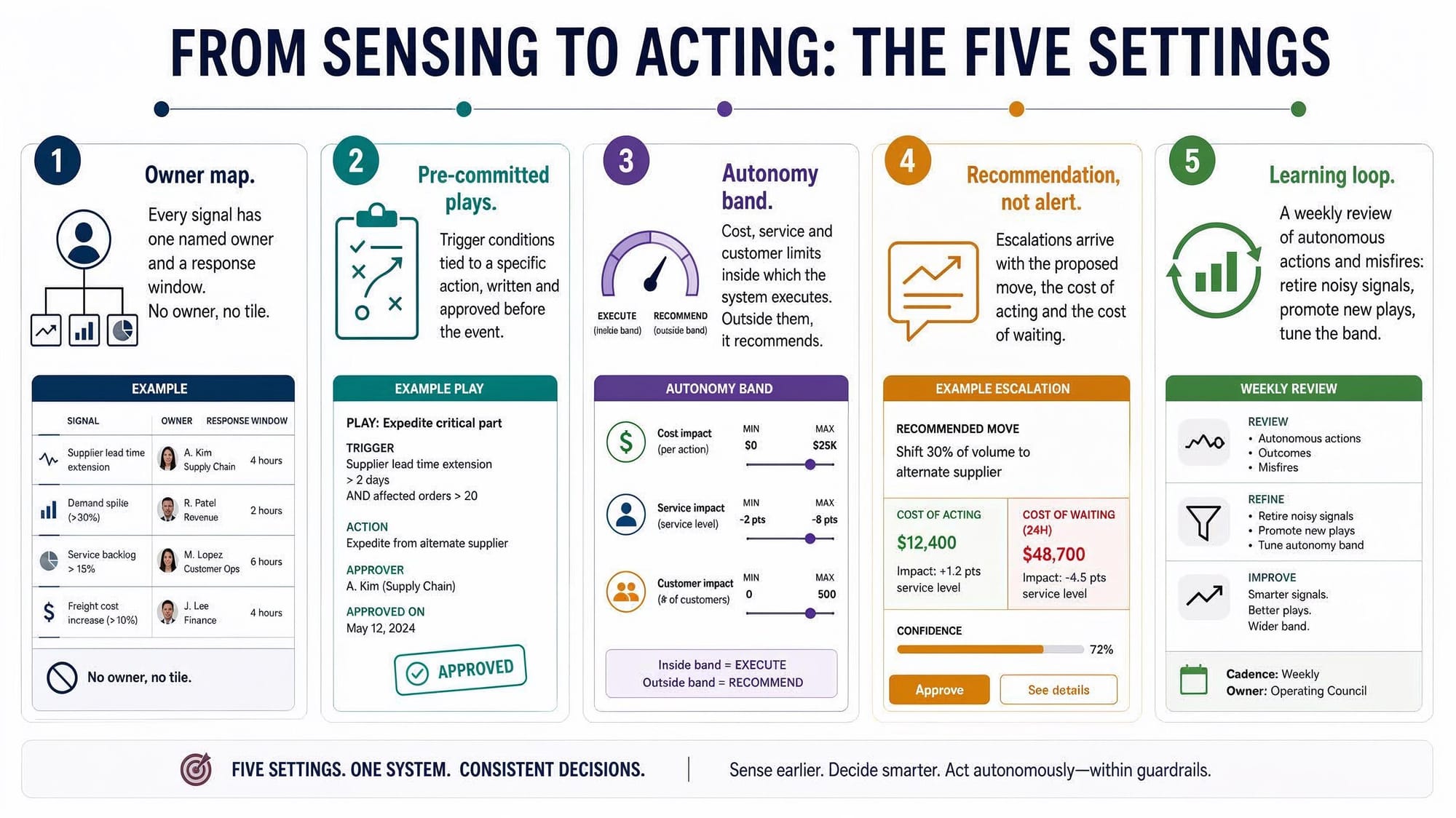
She sat with her leads and went tile by tile with one question: when this goes red, who moves, what do they do, and how fast? Any tile without an answer got deleted, not muted. Weekly alerts fell below four hundred inside a month, and nobody missed what went.
For the signals that survived, she wrote the move before the event instead of during it. A tier-one packaging supplier goes high-risk: reserve alternate capacity, pull two weeks of film forward, protect the promo SKUs first. A hurricane cone touches a DC: book standby carriers, shift stock inland. Those plays became rules the planning system runs on its own, inside cost and service limits Tessa signed. The calls that cross a line — a customer allocation, a spend above the cap — still come to a human, but never as a bare alert. They arrive with the move already built, the cost of making it, and the cost of waiting.
That last part changed the job more than the software did. Her team stopped triaging a wall and started governing a playbook. Every Friday they reviewed what the system had done on its own, which plays had misfired, and which new signals had earned a verb.
She isn’t early. In May 2025 Gartner predicted that by 2030, half of cross-functional supply chain management solutions will use intelligent agents to execute decisions autonomously. Its own planning analysts put mainstream adoption five to ten years out. The space between those two forecasts is where most of us operate today: buying tools that can act and running them as tools that watch.
The storm that never made the deck
The test came in late September. A tropical storm in the Gulf strengthened overnight, and the forecast cone swung over the Houston DC that fed most of the Texas promo volume.
The old wall would have turned red and waited for Monday. This time the play fired at 4:10 a.m. By the time Tessa’s phone woke her, the system had booked standby carriers, moved three days of promo inventory to the inland DC in Dallas, and held exactly one decision for her: whether to trim a regional grocer’s allocation to protect the national account’s promotion. Both costs sat side by side on the screen. She chose in twelve minutes, from her kitchen.
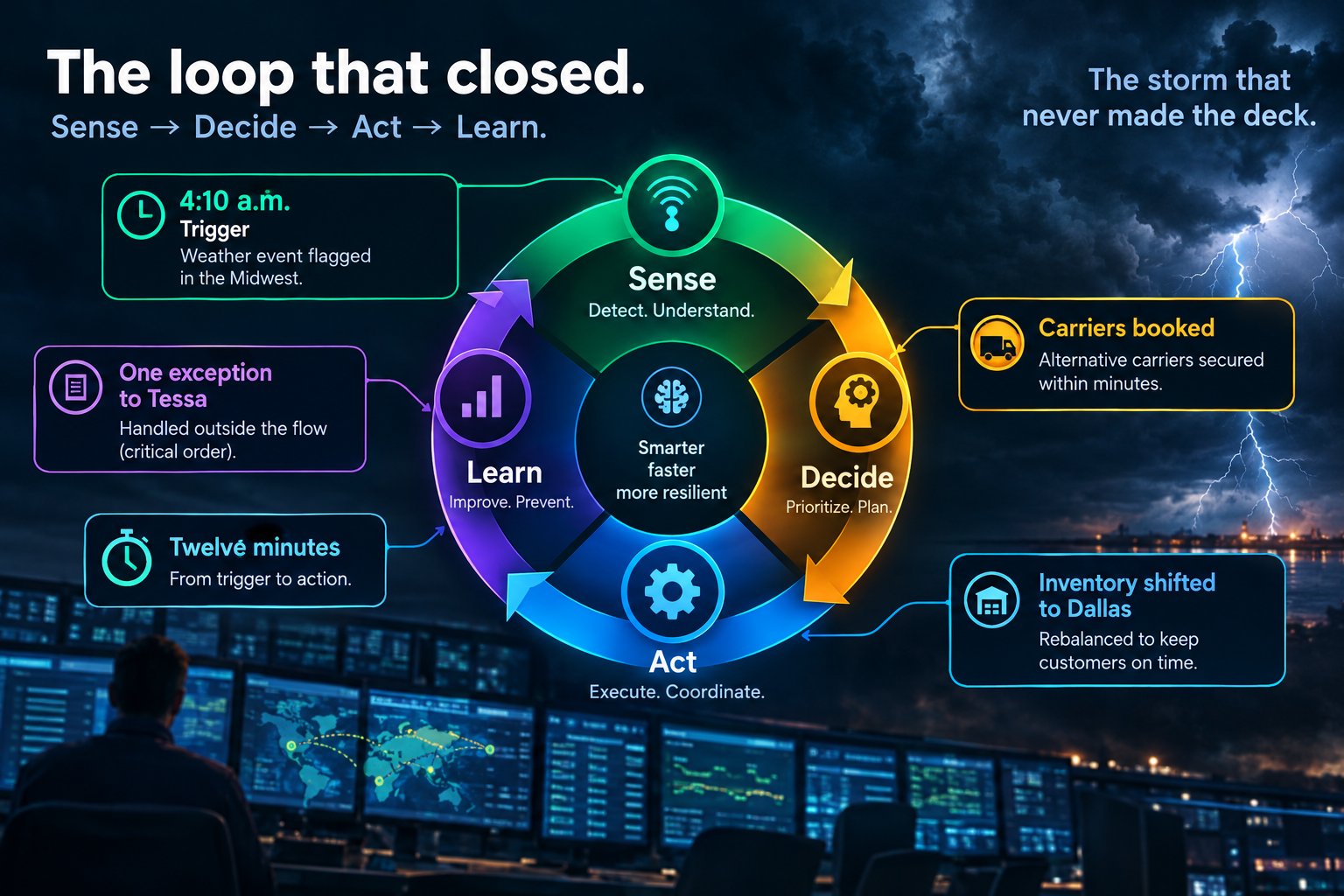
The storm came ashore two days later. Texas shelves stayed full. In Monday’s ops deck the hurricane didn’t get a slide. There was nothing left to watch.
What it asked of the people above her
None of this held on its own. It needed one thing from Tessa’s leadership, and it was harder for them than the software was for her:
Stop funding screens. Fund verbs. Every signal on the wall needs a named owner, a pre-agreed move, and a limit inside which the system acts without asking.
That meant the CFO signing spending limits the system could commit without a meeting. It meant the procurement VP accepting that a rule would sometimes book capacity he would have skipped. And it meant tolerating the occasional play that fired for nothing — because the alternative was six days that nobody owned.
The tile, revisited
The wall is four screens now. Visitors find it a little boring. Most tiles are green, and the ones that turn red don’t stay red long, because something — a rule, or a person holding a ready-made recommendation — is already moving.
Tessa kept one thing from August: a screenshot of the red tile, view counter in the corner. Thirty-one. She shows it to every new hire on day one.
Pick the reddest tile on your control tower right now. Whose job is it to move on it — and if the answer is “everyone’s,” what exactly are you paying it to watch?
Sources cited
• Jan Snoeckx (Gartner), “Agentic AI in supply chain planning: Prepare now to unlock competitive advantage” (Supply Chain Management Review) —
• Michael Riley, Ben Elgin, Dune Lawrence & Carol Matlack, “Missed Alarms and 40 Million Stolen Credit Card Numbers: How Target Blew It”
• The Joint Commission, Sentinel Event Alert, Issue 50: Medical device alarm safety in hospitals