Decision Velocity: 48 Hours to 48 Seconds
Grace’s planning engine rebuilt the plan in ninety seconds. Her company took two days to say yes. This is the story of the weekend that cost her a holiday season — and the rules she wrote so it couldn’t happen again.
At 4:40 on a Friday in late August, Grace’s planning engine did something remarkable. Then her company spent two days ignoring it.
Grace is VP of supply chain at a mid-sized small-appliance maker — espresso machines, air fryers, the countertop gadgets that sell out the week before Thanksgiving. She came up through planning and still reads exception reports the way some people read box scores. She had spent three years, and a serious slice of budget, getting a system that could re-plan the whole network in minutes instead of days.
That Friday, it delivered. A heating-element supplier in Penang emailed a three-week slip on a part that goes into every espresso machine she makes. Within ninety seconds the engine had a new plan on her screen: pull the alternate supplier in Vietnam forward, expedite one air lane, rebalance finished goods between the Memphis and Reno DCs, and protect the retailer that had just committed to a Black Friday endcap.
The math was done before her coffee cooled.
The ninety-second plan that took two days
Here is what happened next. The plan needed a planner to validate it, and the planner had logged off. The expedite cost more than Grace’s approval limit, so it needed finance. Finance wanted the margin impact in their own spreadsheet, not the system’s. Sales wanted to know which accounts would lose allocation before anyone touched allocation. Someone suggested a call. Someone else suggested waiting for Monday’s S&OP huddle, “so everyone’s in the room.”
Grace sent the email she still thinks about: Let’s regroup Monday.
The room finally said yes on Sunday evening, after fourteen emails and three versions of the same workbook. By then the Vietnam supplier’s spare capacity had gone to a company that answered faster, and the air slots were gone with it. The endcap shipped short. The retailer filled the gap with a competitor’s machine, and finance later put the damage at roughly $1.8 million in lost holiday revenue and penalties.
The plan was right. It just arrived at a company that couldn’t hear it.
The whiteboard with one thin line
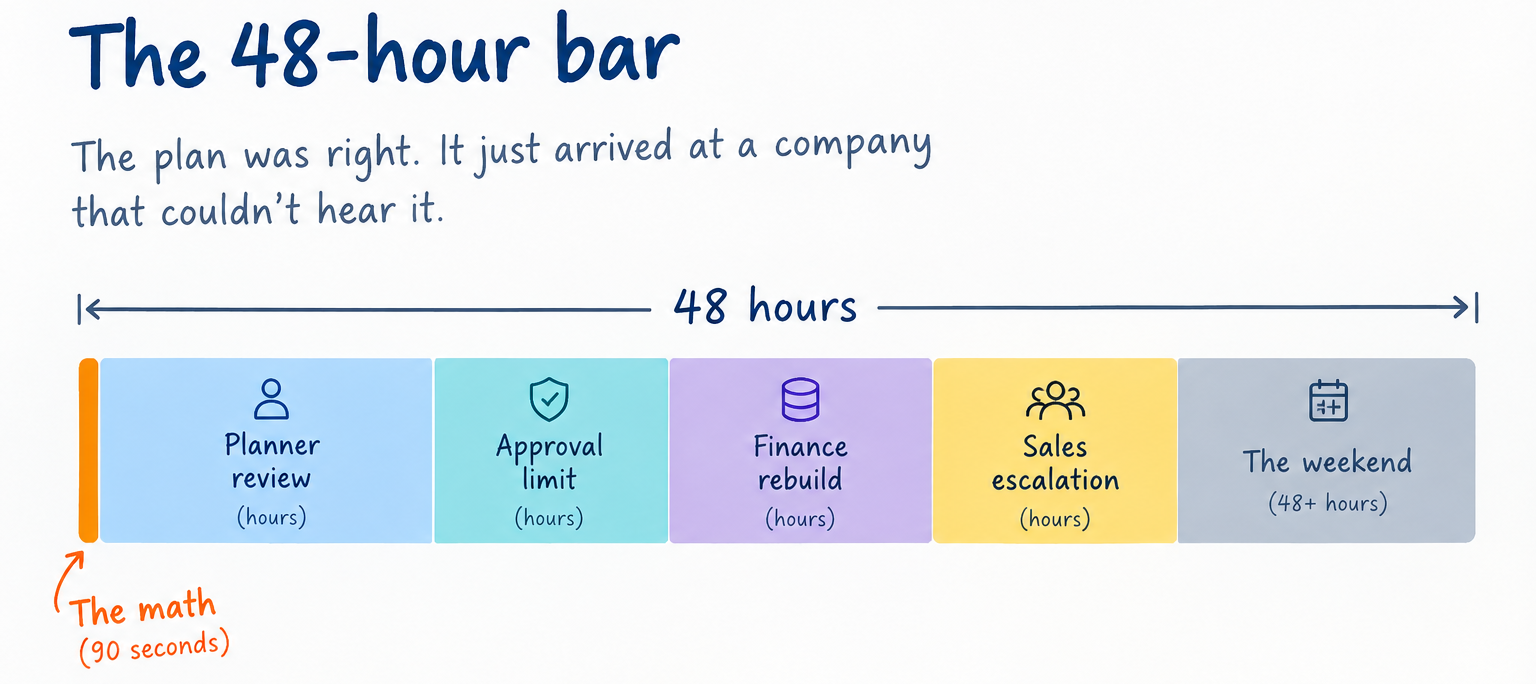
The post-mortem started the usual way: blame the supplier, then blame the forecast. Grace stopped it. She walked to the whiteboard, drew one long horizontal bar and labeled it 48 hours. Then she drew a sliver at the left edge, barely the width of the marker, and wrote: the math.
Everything else on that bar was waiting. Waiting for a planner. Waiting for an approval limit. Waiting for a spreadsheet to be rebuilt by people who didn’t trust the first one. Waiting for a meeting whose only purpose was to get permission into a single room.
“We didn’t have a planning problem,” she told her team. “We had a permission problem dressed up as one.”
THE REFRAME
The latency was never in the engine. It was in the org chart — in who was allowed to say yes, and how long it took to find them.
She isn’t alone, and the research is unkind about it. In McKinsey’s global survey Decision making in the age of urgency (April 2019, more than 1,200 respondents), only 37 percent said their organizations’ decisions were both high-quality and fast — and the organizations that decided quickly were twice as likely to make high-quality decisions as the slow ones. Speed and quality weren’t trading off. They traveled together.
Gartner’s supply chain practice put a sharper point on it this July in Close the Decision Execution Gap Through AI and Automation: supply chains are getting faster at deciding, yet still struggle to turn those decisions into action. Grace’s weekend was that gap with a dollar figure attached.
Deciding how to decide
Her engine was already fast, so the fix wasn’t a faster engine. It was writing the decisions down before the next disruption, while nobody was panicking.
She borrowed the idea from an emergency room. Nobody in a trauma bay convenes a committee to decide whether to start CPR. That was decided years earlier, in a quiet room, by people who knew the moment would come. The protocol is the decision; the nurse executes it.
So Grace and her CFO spent six weeks on the least glamorous work of her career: sorting every recurring supply chain decision by how much it could hurt if it went wrong, and agreeing — in advance, in writing — who owned each one.
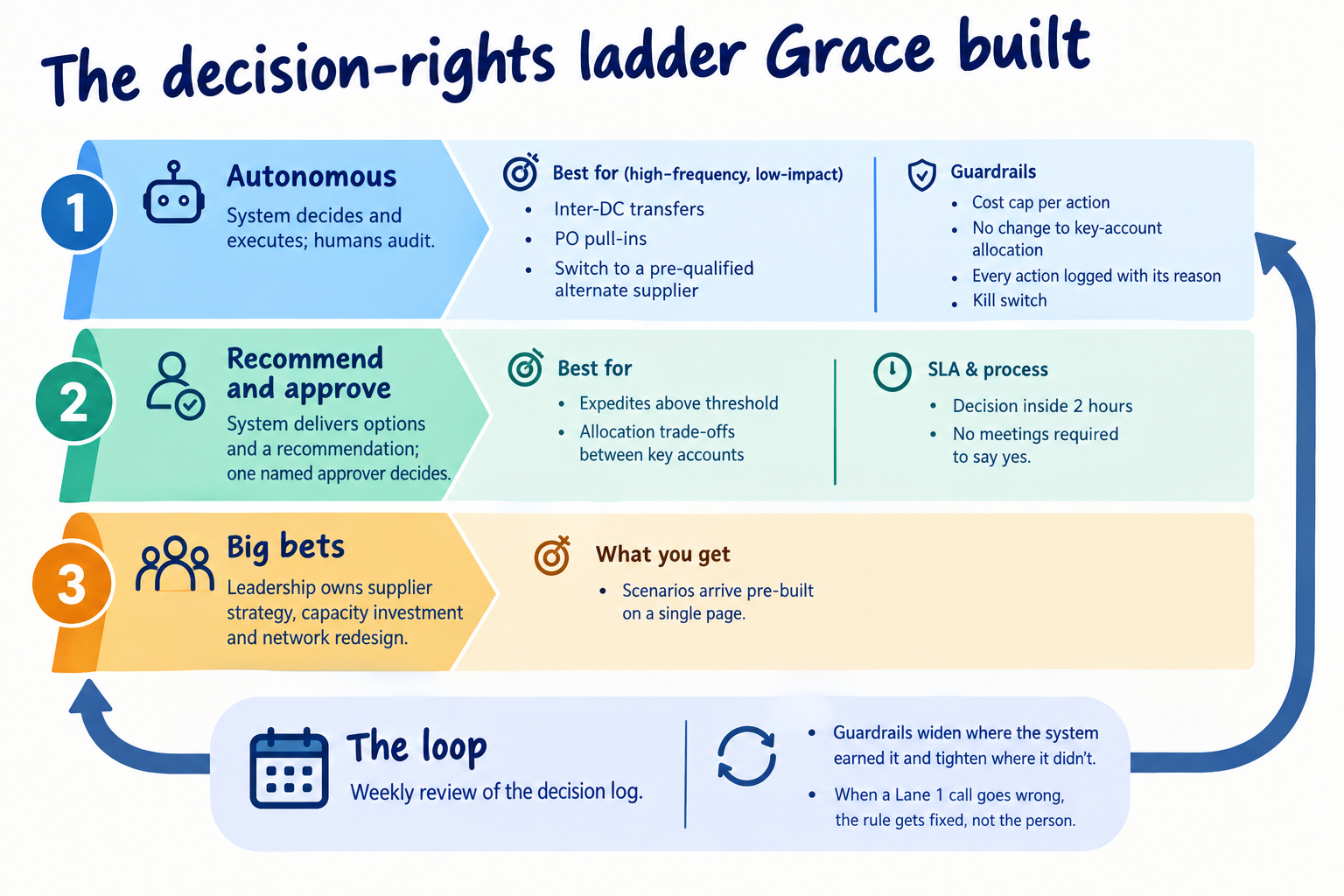
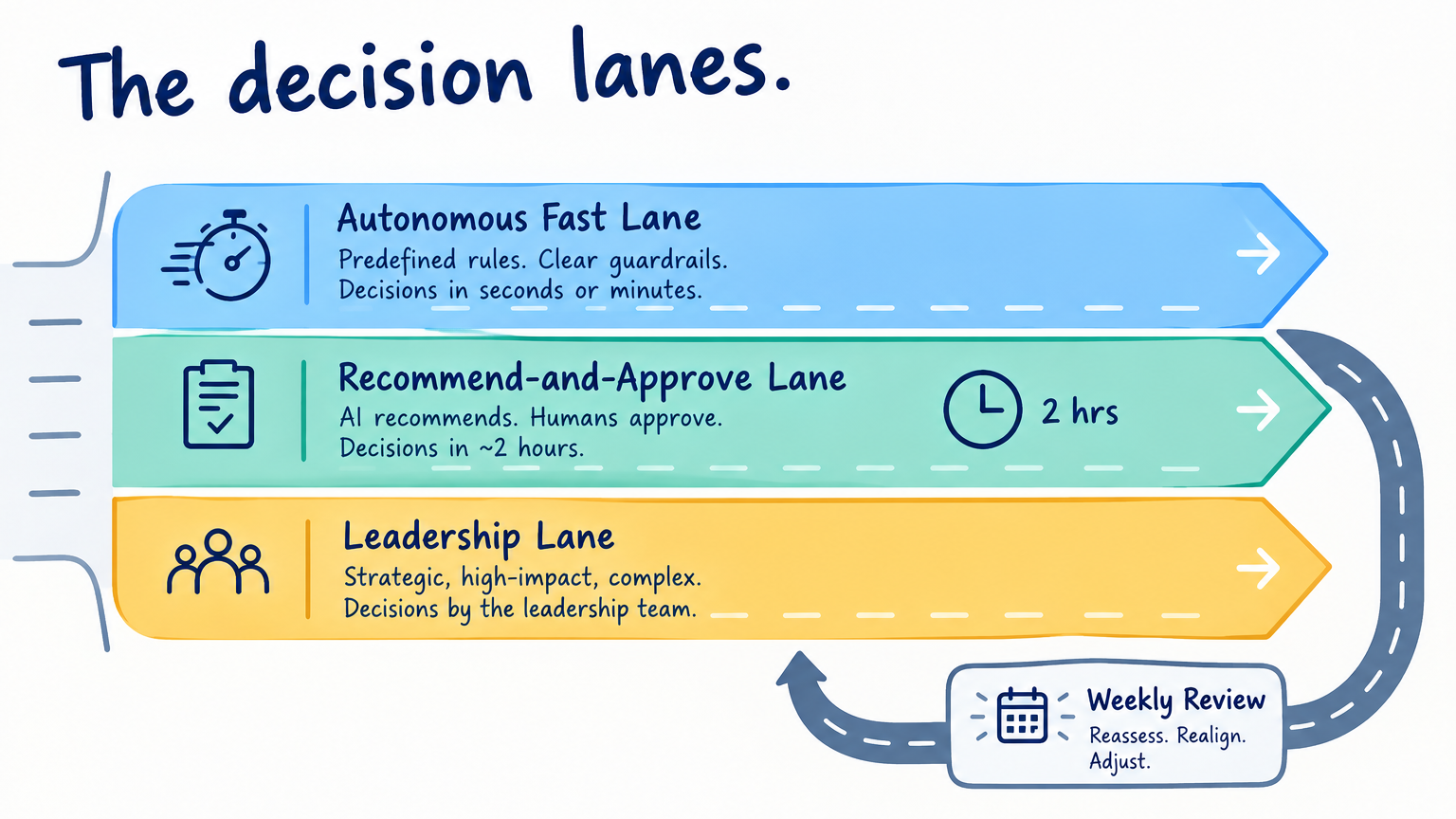
Most decisions turned out to be small and frequent: moving stock between DCs, pulling a PO forward, switching to a pre-qualified alternate. Those went to the system, inside hard limits on cost and customer impact, with every action logged. A smaller set needed judgment, so each got one named approver and a two-hour clock instead of a meeting. The rare big bets stayed with leadership, but now they arrived pre-built on a single page.
The CFO’s condition was what made it stick. If an autonomous call went wrong inside the guardrails, nobody would be hauled in to explain why they “let the system do it.” They would fix the rule, not punish the person.
Forty-eight seconds
The test came on a Wednesday morning in March. A fire at a resin supplier’s plant took out the housings for her best-selling air fryer — the kind of news that, a year earlier, would have eaten a weekend.
This time the clock ran differently. Forty-eight seconds after the supplier’s alert hit the system, the routine moves were committed: a confirmed order with the pre-qualified alternate, stock swapped between two DCs, and the assembly line re-sequenced to run espresso machines first. Every action sat in the log with its reason attached.
One decision fell outside the guardrails: which of two national retailers would absorb a ten-day gap. That one came to Grace with both options costed and the system’s recommendation on top. She called the CFO. They decided in six minutes — and overruled the system on one account, because Grace knew that retailer’s shelf-reset calendar and the system didn’t.
Nobody wrote “let’s regroup Monday.” There was nothing left to regroup about.
The approval nobody waits for
Grace’s job changed more than her software did. She used to be the approval everyone waited for. Now she spends her time on the rules: reading the decision log every Friday, widening a guardrail where the system earned it, tightening one where it didn’t. Her planners stopped being couriers between a screen and an inbox.
She is clear-eyed about the risk. In a June 2025 release, Gartner predicted that at least 15 percent of day-to-day work decisions will be made autonomously through agentic AI by 2028, up from zero in 2024 — and in the same breath warned that more than 40 percent of agentic AI projects will be canceled by the end of 2027 over cost, unclear value or weak risk controls. Grace reads those two numbers as one sentence. Speed without decision rights is faster chaos. Decision rights without speed is her old weekend.
WHAT THIS ASKS OF LEADERSHIP
Approve the guardrails in peacetime. And when a call inside them goes wrong, change the rule — don’t punish the person who trusted it.
Back to Friday at 4:40
Grace still keeps that Friday email in her sent folder. It reminds her that the most expensive part of that weekend wasn’t the supplier or the freight. It was the gap between knowing and doing — and the fact that no one had decided, in advance, who was allowed to close it.
The engine was never the bottleneck. The permission was.
THE QUESTION TO SIT WITH
Pull up the last disruption your team handled. How many of those hours were the math — and whose “yes” were you waiting on for the rest?
Sources cited
McKinsey & Company, Decision making in the age of urgency (McKinsey Global Survey, April 30, 2019)
Gartner, Close the Decision Execution Gap Through AI and Automation (research note, July 9, 2026)
Gartner, “Gartner Predicts Over 40% of Agentic AI Projects Will Be Canceled by End of 2027” (press release, June 25, 2025)