The Man Who Overrode the Machine

Markus built a career, being right when the software was wrong. Then the software learned to ask why — and he had to figure out what was left of him that couldn't be automated.
Markus has a reputation. Nineteen years planning inventory across three industries, and the thing people say about him — the thing he likes people to say about him — is that he knows when to ignore the system. When the planning engine flashes red and tells everyone to panic, Markus is the one who leans back, looks at the screen, and says: leave it. The ship's a week out. That dip into safety stock is exactly what safety stock is for. Go get a coffee.
He's usually right. That's the part that matters. A junior planner or a rigid piece of software sees inventory cross the red line and books a $90,000 emergency air freight to fix a problem that was never going to happen — and two days later the sea freight arrives on schedule and the warehouse is drowning. Markus has saved his company that mistake more times than anyone has counted, because he carries things the software doesn't. He knows a supplier in Lyon quietly shuts for the whole of August no matter what the contract says. He knows which client's VP fakes a Q4 emergency order to burn budget before year-end. None of it is written down anywhere. It lives in his head.
For thirty years, that head — his, and the heads of a few thousand veterans like him — has been the invisible patch holding the global supply chain together. The satellites and the quantum-optimized routing are real. So is the yellow sticky note on the bottom of the monitor. Markus is the sticky note. And he has always assumed that made him safe.
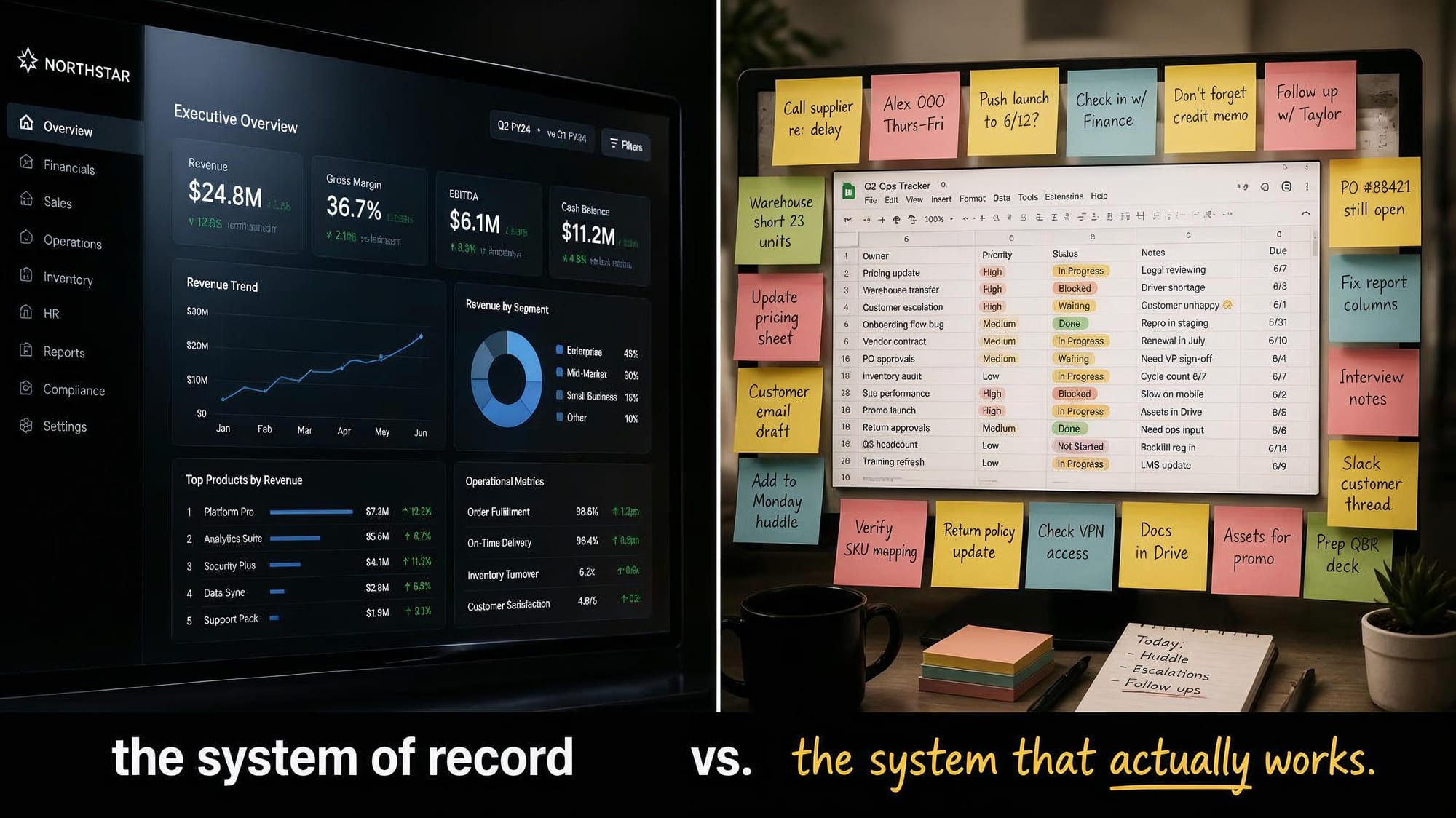
The morning the machine asked him why
The break didn't arrive as a crisis. It arrived as a dialog box.
His company rolled out an agentic planning layer — not a smarter dashboard, but a system that acts. It reroutes, it reorders, it adjusts. And the first week, Markus did what Markus does: it recommended an expensive expedite, he overrode it, and he reached for his coffee. Except this time the screen didn't just log the override. It asked him a question, in plain language: “I see you rejected the air-freight recommendation. What did you know that I didn't?”
So he told it. He typed the thing about the ship being a week out, about the dip being normal during an open replenishment window. And the system wrote it down — not as a note, but as a rule it could apply the next time, and the time after that. Markus sat there and felt something cold move through him. He had just trained his own replacement, and it had taken forty seconds.
Here is what nobody in the room said out loud, so I will. The most valuable thing Markus did — the override, the hard-won intuition, the knowing — was exactly the thing the machine had just learned to capture. His technical mastery wasn't a moat. It was a dataset waiting to be collected.
The wrong question, and the better one
Markus spent a bad couple of weeks asking the question almost everyone in his position asks first: how do I stay indispensable? How do I protect what I know? It's the natural reflex, and it's a trap. Adam Grant has a name for the mode it puts you in — you become a preacher, defending your sacred spreadsheet; or a prosecutor, attacking the new system to prove it's flawed. Neither one learns anything. Both just dig in.
The reframe, when it came, was not about intelligence. Markus is plainly smart; IQ was never his problem. It was about something the research has started calling the Adaptability Quotient — AQ, the capacity to unlearn a mental model that used to work and rebuild on a better one, on purpose, while it still feels like a loss. Not raw brainpower. Not accumulated experience. The specific, uncomfortable skill of letting go of the thing you were best at.
The most dangerous asset in a volatile world is a hard-won skill that has quietly stopped being scarce. AQ is what lets you notice, and move, before the market notices for you.
This is measurable, not motivational-poster talk. The World Economic Forum's Future of Jobs Report 2025 finds that 39% of workers' core skills will be disrupted by 2030, and that the fastest-rising cluster employers now name — right alongside analytical and AI skills — is resilience, flexibility and agility. Adaptability has moved from soft skill to survival skill. What Markus was feeling wasn't a personal failing. It was the leading edge of a structural shift, arriving at his desk a few years early.
Edgar Schein mapped the emotional physics of it decades ago. Real change is a fight between two anxieties: survival anxiety — the fear that if you don't adapt, you're finished — and learning anxiety — the fear of looking incompetent while you try. We change only when survival anxiety wins. But the cruel twist is that you can't bully yourself across that line by cranking up the fear; panic doesn't produce learning, it produces preachers and prosecutors. The only way through is to make the learning feel survivable. Markus had to lower his own learning anxiety before his AQ could do anything for him.
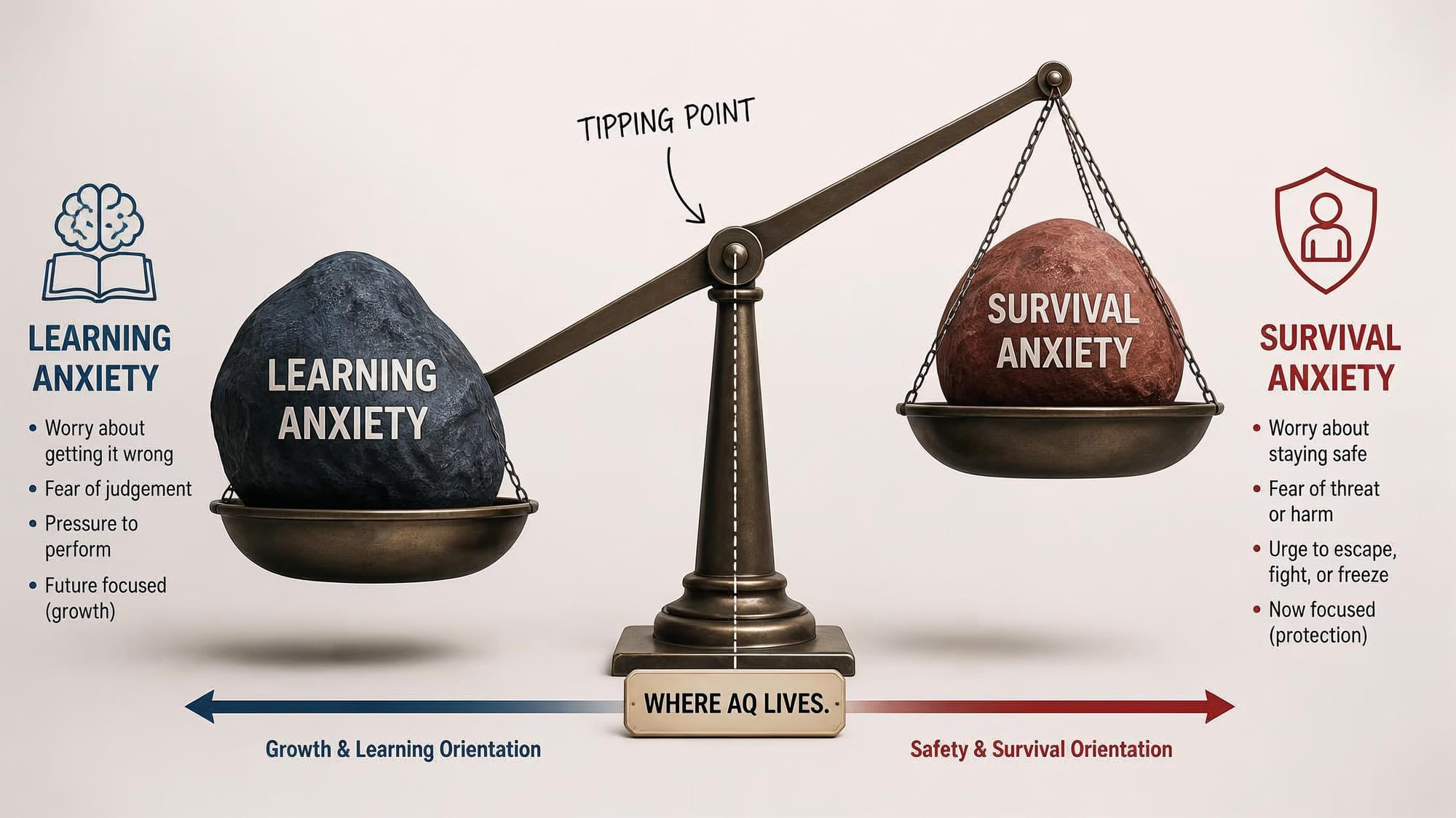
What he did on a random Tuesday
The shift didn't happen in a workshop. It happened in the smallest possible increments, which is the only way this kind of change ever actually happens.
Markus stopped trying to out-know the machine on the routine stuff and started doing something that felt, at first, like a demotion. He let the system run the high-frequency, low-stakes decisions — the routine replenishment, the standard reorders — hands-off. He kept his hands on the high-stakes calls, where the AI drafts the move and a human still has to click approve. And the genuinely strategic, once-a-quarter bets, he used the machine to pressure-test rather than make. He wasn't fighting the system for territory anymore. He was deciding, deliberately, which territory was his.
Then he did the thing that actually rewired him. Every Friday, before closing his laptop, he took five minutes and asked two questions. Did I unlearn one legacy habit this week — one report I stopped sending, one override I let the system handle? And did I spend my week on the architecture, the judgment, the guardrails — or did I get sucked back into executing tasks the machine should own?
James Clear's whole argument is that you don't rise to your goals, you fall to your systems, and that identity change comes from small votes repeated, not grand declarations. Markus wasn't trying to become adaptable by Friday. He was casting one small vote, every Friday, for a different idea of who he was.
The old vote was: I'm the expert who executes. The new one was: I'm the architect who sets the rules the machine runs on. And once that identity took, the daily habits stopped feeling like a loss and started feeling like the actual job — the one he'd wanted before the friction of the old way buried it.
Stop rewarding people for being the smartest person who touched the spreadsheet. Start rewarding them for the legacy habit they had the nerve to give up.
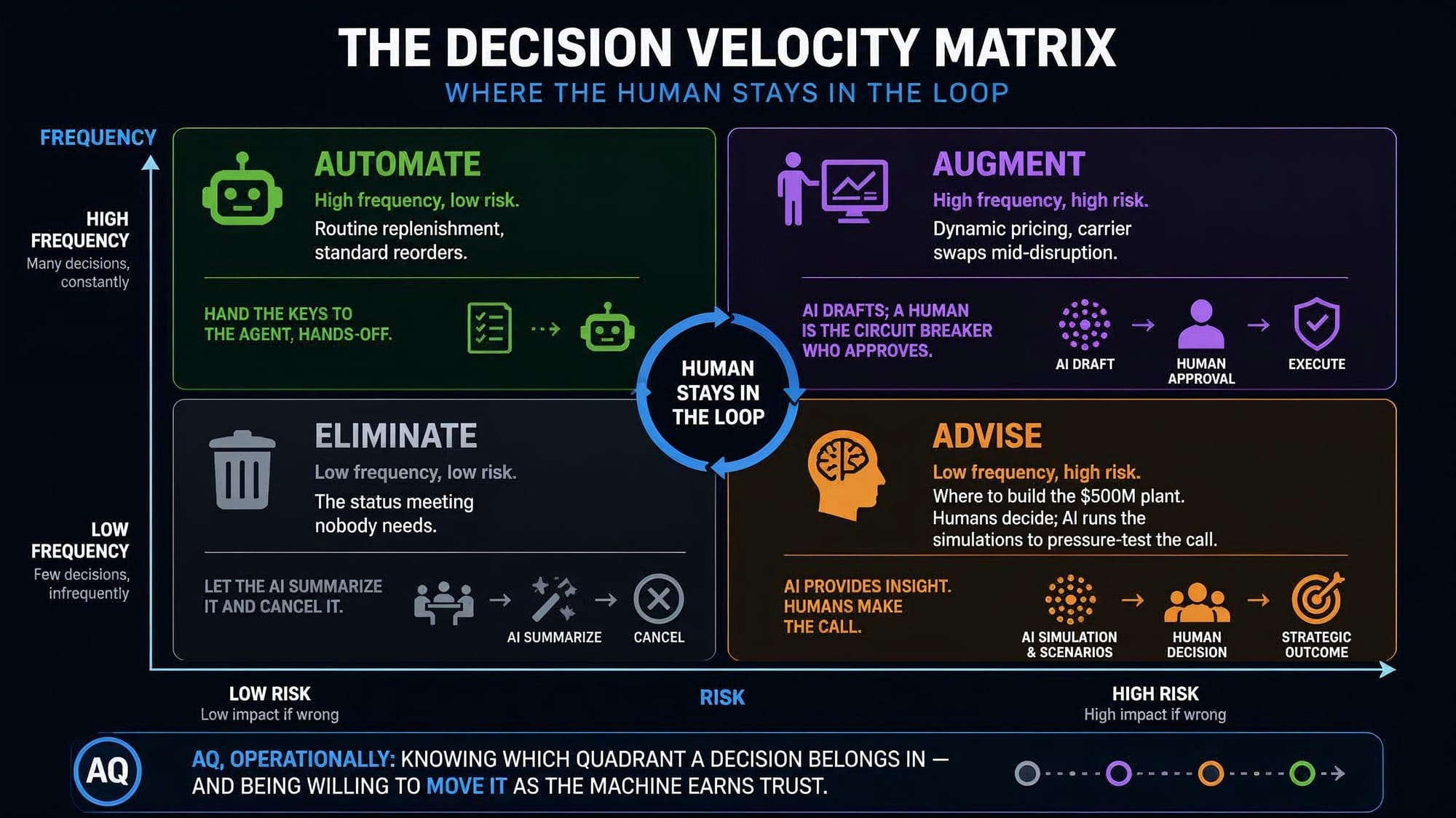
The apprenticeship problem he couldn't ignore
There's a catch in this story I won't pretend away, because Markus couldn't. If the machine now does the grunt work — cleans the messy data, chases the routine exceptions — then how does the next Markus ever learn what he learned? His intuition didn't come from a manual. It came from three years of manually fixing other people's currency-coding errors and slowly understanding why the data was messy in the first place. Automate the training wheels and you get a generation that can consume the AI's answers but can't audit them.
So Markus made that his new work, too. He started putting junior planners in the seat as auditors, not consumers — forcing the system to show its reasoning step by step, teaching them to interrogate the machine's logic the way he once interrogated his own gut. High AQ, it turns out, isn't a solo trait. The most adaptable thing a veteran can do is build the conditions for the next veteran to exist at all.
He isn't the man who overrides the machine anymore. He's the man who decides what the machine is allowed to do, teaches it what he knows, and trains the people who'll audit it when he's gone. His empathy, his judgment, his feel for how the network actually behaves under stress — none of that got replaced. It got promoted. The tactical work he used to be proud of was the floor. Adaptability is what let him find the ceiling.
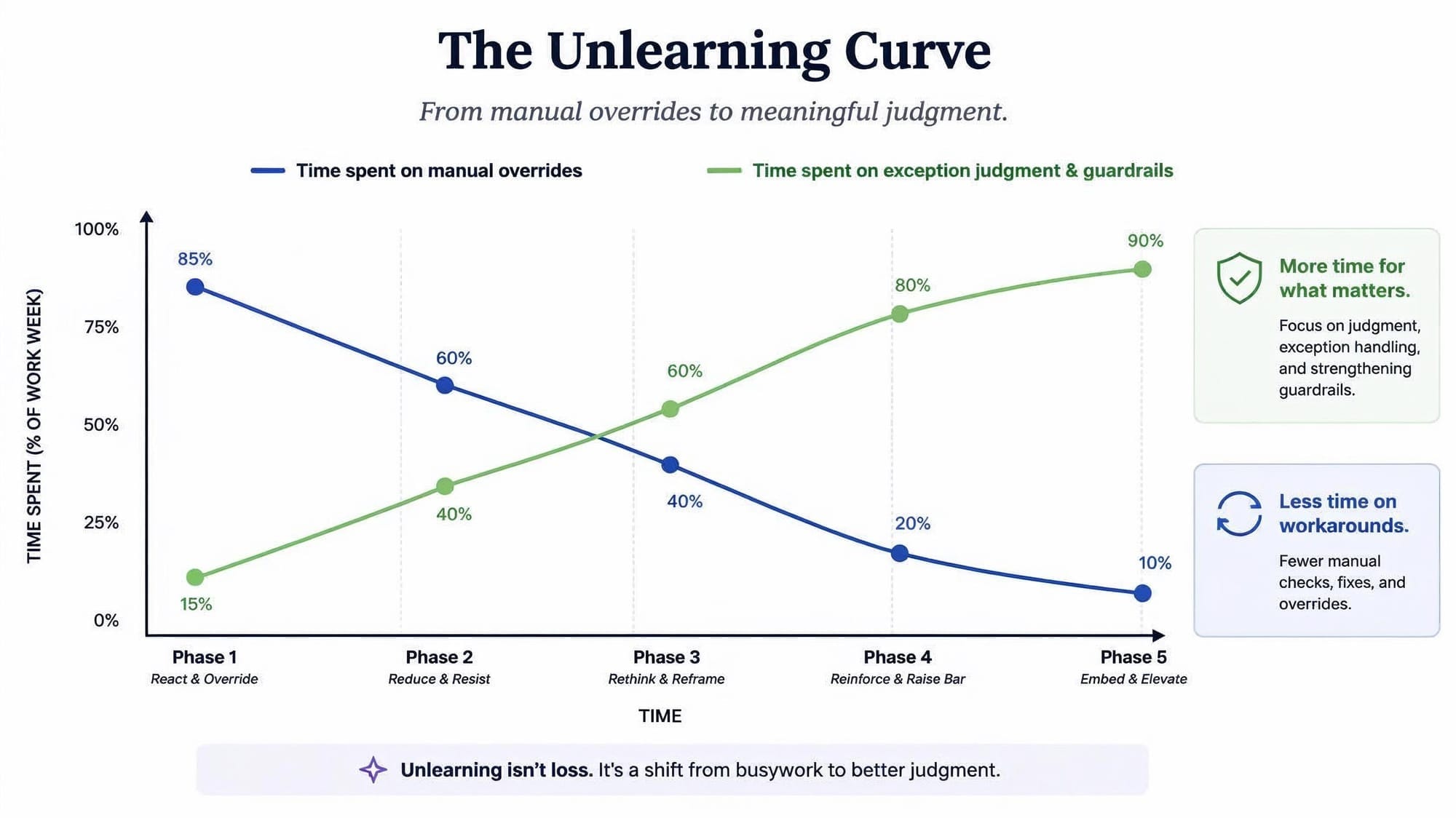
Which brings the whole thing back to the sticky note. For thirty years the note was the intelligence — the patch that kept the system from falling over. The software has finally arrived to take the note off the monitor. The question is no longer whether it can. It's what you become once it does.
Your technical edge is depreciating whether you look at it or not. Your adaptability is the only asset that compounds. So: which skill are you still defending because you're good at it — and what would it cost you to be the one who lets it go first?
Sources cited
World Economic Forum, Future of Jobs Report 2025 (Jan 2025) — 39% of core skills disrupted by 2030 (down from 44% in 2023); 22% structural job churn; “resilience, flexibility and agility” among the top rising skills; analytical thinking the #1 core skill.
MIT NANDA / Media Lab, The GenAI Divide: State of AI in Business 2025 — 95% of enterprise GenAI pilots deliver no measurable P&L impact; failure attributed to the organizational “learning gap,” not model quality.
Edgar H. Schein, “How Can Organizations Learn Faster? The Challenge of Entering the Green Room” (MIT Sloan Management Review) — survival anxiety vs. learning anxiety; change requires survival anxiety to exceed learning anxiety while lowering the latter.
Adam Grant, Think Again (2021) — the preacher / prosecutor / politician modes vs. the scientist's mindset; “confident humility.”
James Clear, Atomic Habits (2018) — “we do not rise to the level of our goals; we fall to the level of our systems”; identity-based habits; marginal gains.
Hau L. Lee, “The Triple-A Supply Chain” (Harvard Business Review, Oct 2004) — agility, adaptability, alignment as the traits of dominant supply chains.