The Four Hundred Calls She Stopped Defending
Elena spent twenty years being the person who made the call. Then an agent started making four hundred of them a day — and she had to figure out which nine were still hers.
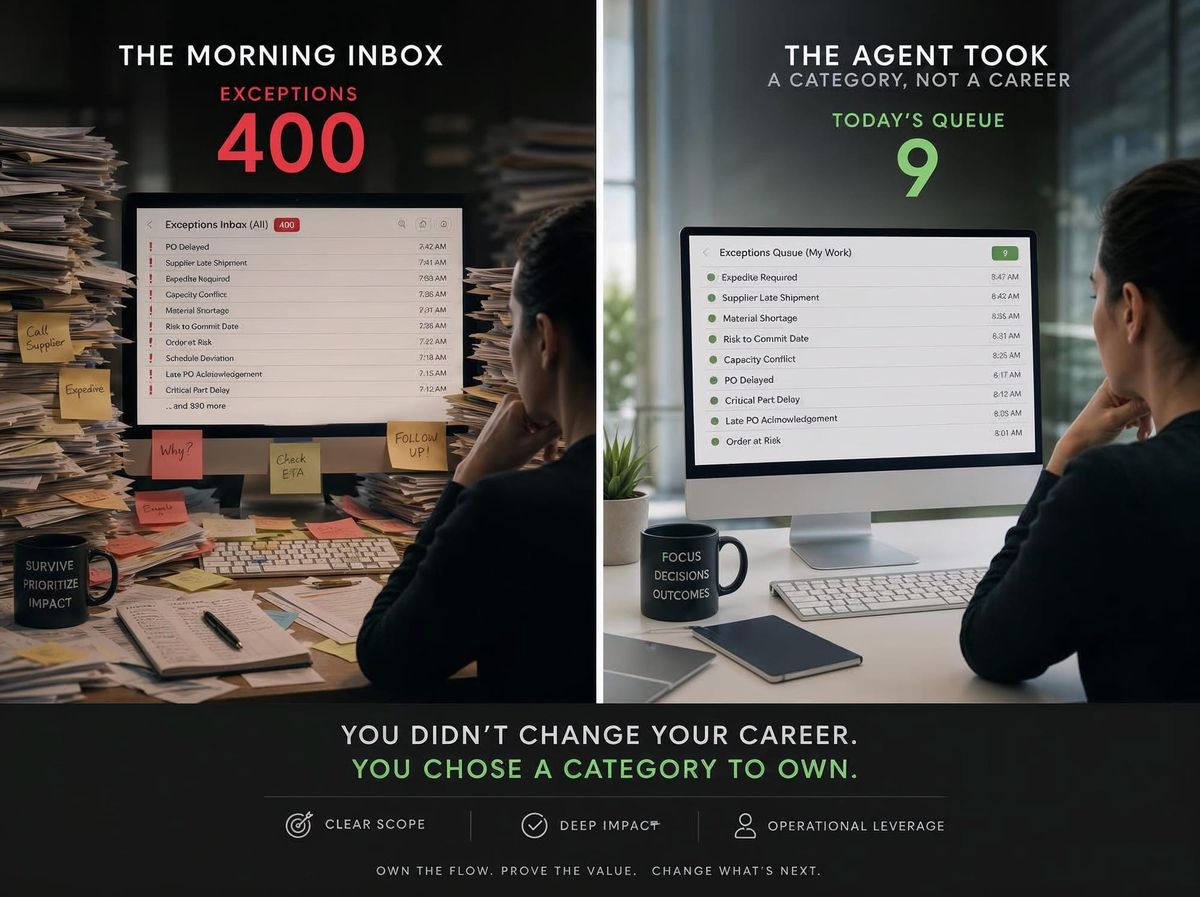
Elena does not remember the exact day the queue changed. She remembers the feeling. She sat down on a Tuesday, opened the planning system the way she had every morning for twenty years, and the exceptions that used to fill her screen — the four hundred replenishment calls, the transfer approvals, the reorder confirmations — were gone. Not deleted. Handled. An agent had cleared them overnight, and left her nine items. Nine.
For a second she felt the thing nobody in these rollout meetings ever says out loud: relief, and right behind it, a cold drop in the stomach. If the machine can clear three hundred and ninety-one of my decisions before I've had coffee, what exactly is the job I've been proud of for twenty years?
Here is what Elena got wrong in that first cold second, and it took her a bad month to see it. She assumed the agent was coming for her. It wasn't. It was coming for a category. And the difference between those two things is the whole story of what happens to a planning career over the next five years.
The morning the queue emptied
For thirty years, supply chain work was sorted by seniority. Junior people ran the transactions. Senior people made the calls. The org chart followed the logic, and everyone understood the ladder they were climbing. Elena climbed it. She was good at it. The thing people said about her— the thing she liked people to say — was that she had a feel for the network nobody could quite write down.
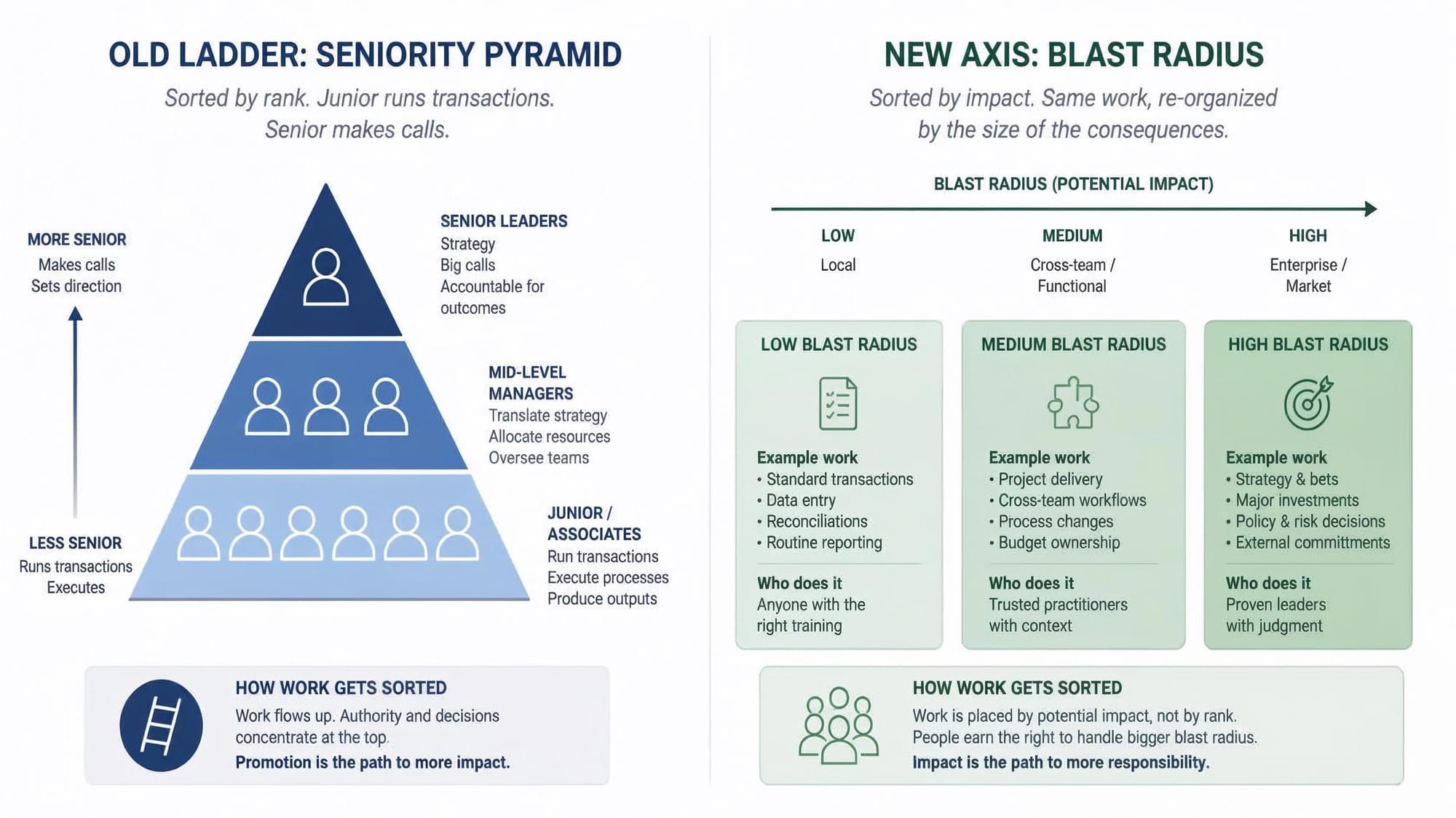
Agentic AI does not respect that sort. It re-ranks the work on a completely different axis: not who is senior enough to decide, but how much a decision costs when it goes wrong, and how fast the ground moves underneath it. In the rollout deck someone had a name for it — blast radius. What does this decision cost if it's wrong, multiplied by how hard it is to undo?
Replenish a fast-moving SKU into a regional DC. Known distribution, small blast radius, four hundred times a day. That decision is leaving. It should leave. Commit constrained supply to a launch quantity, or protect a strategic customer at the expense of margin in a tight quarter. No clean distribution, a judgment about who you want to be as a supplier, a mistake you cannot walk back. That one stays.
This is not a vendor's slogan. Gartner now expects 60% of supply chain disruptions to be resolved without human intervention by 2031 — a forecast anchored to an October 2025 survey of 509 supply chain leaders, who named AI-driven changes in ways of working as the single biggest force on performance over the next two years. Read the claim precisely. It does not say 60% of planners disappear. It says a whole class of decision stops needing a person in the loop.
The threat to Elena's career was never the agent. It was spending three more years defending the four hundred routine calls instead of claiming the nine that carry real consequence.
Why the loop was never about safety
Elena's instinct, that first month, was to prove the agent wrong. She went hunting for its mistakes. She found a few, held them up in meetings, felt briefly vindicated. Adam Grant has a name for the mode this puts you in — you become a prosecutor, building the case against the new system to protect your standing. And prosecutors don't learn anything. They just win small arguments while the ground keeps moving.
The reframe, when it came, came from a piece of research that has nothing to do with supply chain and everything to do with Elena. In a set of forecasting studies, people who were shown a demonstrably superior algorithm still refused to use it once they'd seen it err — the researchers called this algorithm aversion. But the fix was almost absurdly small. Let people adjust the algorithm's output, even slightly, even within tight limits, and they adopted it readily and performed better for it.
Sit with what that means. The human-in-the-loop is not primarily a safety feature. It is an adoption feature. The loop is the thing that makes a powerful model usable by the people who have to live with its decisions. Which means Elena was never the obstacle to automation. She was the precondition for it. The org had been treating her oversight as a courtesy it was slowly withdrawing. It was actually the mechanism that made the whole system work.
That single shift changed the question she was asking. Not "how do I stay indispensable?" — the prosecutor's question — but "which decisions should carry my judgment, and how do I encode that judgment so the agent honors it?" That question has an answer. It has a job description, even. Almost nobody has written it down.
The four settings she had to design
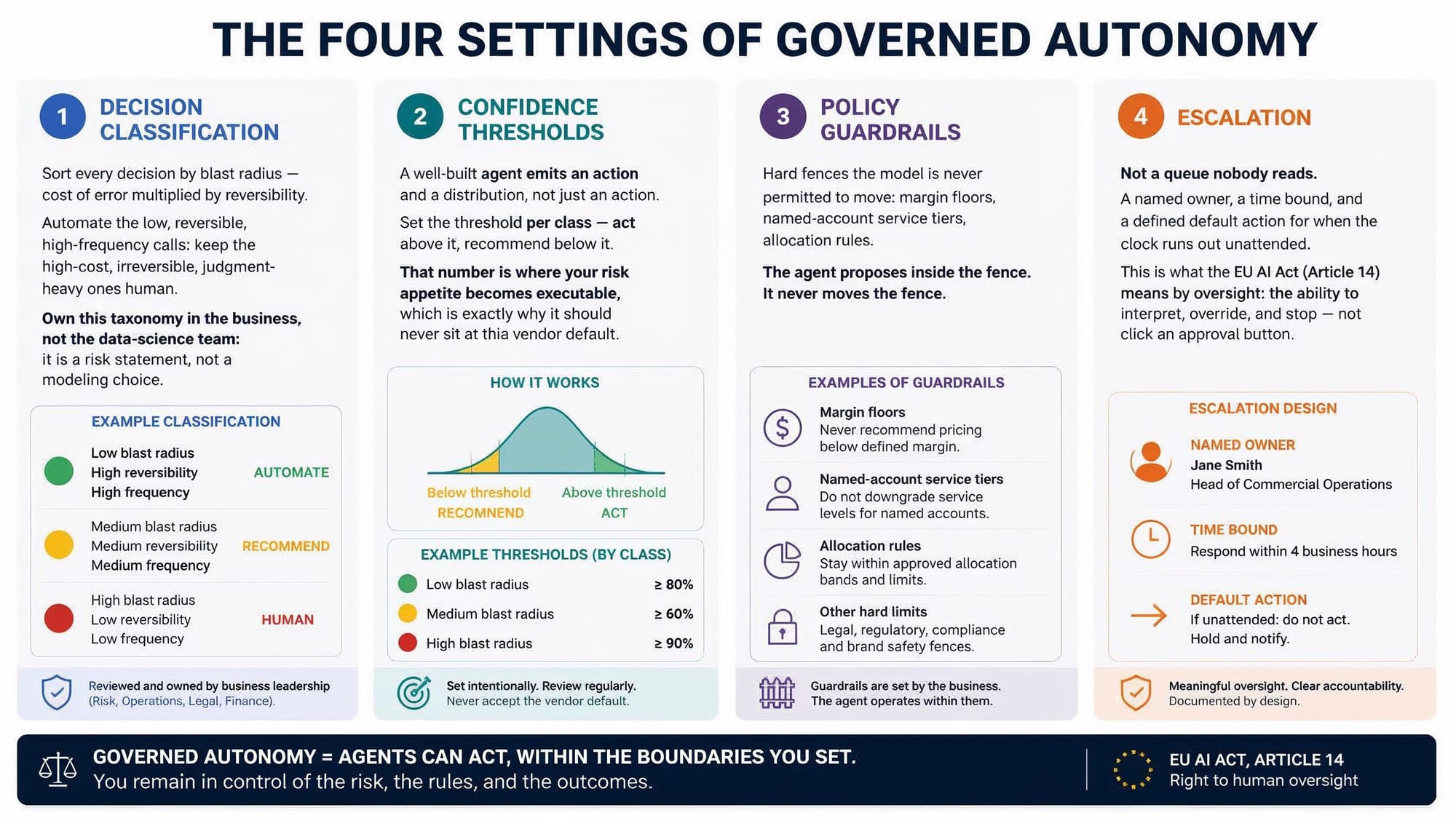
Elena stopped auditing the agent's mistakes and started designing the fence it ran inside. Autonomy, she learned, is not a switch you flip. It is four settings that only work when they're designed together — and most deployments build one of them and hope.
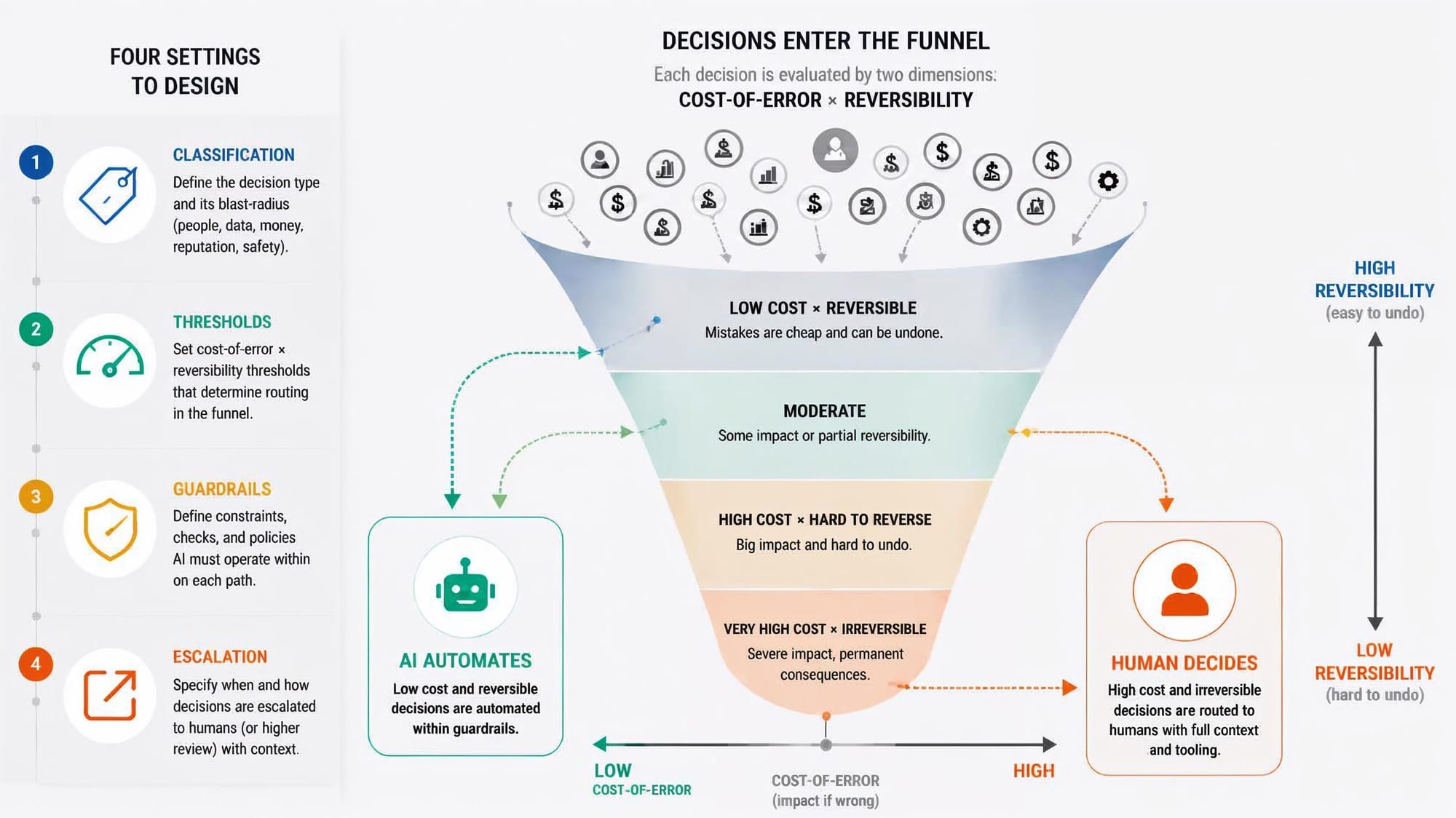
In the language of her actual week: she decided which classes of decision the agent could touch at all, sorted by blast radius rather than by who used to own them. She set the confidence bar per class — act above it, ask below it — so the system's boldness matched the cost of being wrong instead of running at whatever number the vendor shipped. She drew the hard policy fences the model could never optimize away: margin floors, service tiers for named accounts, allocation rules that hold no matter what the math concludes. And she built the escalation path — not a queue nobody reads, but a named owner, a time bound, and a defined default for when the clock runs out at two in the morning.
None of this came from a manual. It came from twenty years of knowing which of the four thousand rules in the system were load-bearing and which were scar tissue from a 2020 shortage — knowing that plant 12's capacity number is aspirational in July, that a certain account's VP fakes a Q4 emergency to burn budget. That knowledge was never in the model. It is the raw material for the fence.
The call that came at 2 a.m.
Eight months in, the test arrived. A key supplier went dark overnight, right as a constrained launch was ramping. The old Elena would have been awake at two, doing arithmetic against numbers she half-trusted, phone hot against her ear. This time the agent had already re-shuffled the reversible allocations under the thresholds she'd set, held every margin floor she'd drawn, and pushed exactly one thing to her screen: the launch-commitment call, flagged, because she had classified it as hers. High blast radius. Not reversible.
She made one decision before her coffee went cold. The agent executed the other four hundred around it. The plant that used to call her at two never called. And Elena noticed something she hadn't expected to feel: this was the job she'd wanted before the volume of routine work buried it. Orchestrating the network. Protecting the accounts that mattered. Spending her judgment on the ten decisions that deserved it instead of rationing it across four hundred that didn't.
Stop measuring planners solely on forecast accuracy. Start rewarding them for the guardrails they designed and the exception policy nobody else in the building could have written.
Because here is the cruelty the reassurance emails miss. "AI won't replace you" is true, and it lands as nothing, because it names no future at all. It only promises the absence of an ending. What Elena needed was not comfort. She needed the next rung — a role with a scope, a title, and a pay band that measures the thing she actually now does. That document is what most organizations still haven't written, and its absence is doing more damage to retention right now than any agent is.
Back to the nine items
Elena still opens the system every morning. The queue is still short — some days nine items, some days three. But she reads it differently now. The empty space where four hundred decisions used to be isn't a measure of what was taken from her. It's a measure of what she finally has room to do.
She isn't the woman who makes the call anymore. She's the woman who decides which calls are worth a human, encodes the judgment that governs the rest, and trains the planners who'll audit the agent when she's gone. Her feel for the network — the thing nobody could write down — didn't get automated. It got promoted into the architecture. The tactical work she used to be proud of was the floor. Designing the system that runs on her judgment turned out to be the ceiling.
The re-ranking is coming for the category, not the person. The planners who come out of it ranked higher won't be the ones who fought automation hardest. They'll be the ones who could say, precisely and out loud, which of their decisions deserved a human — and why.
Which decisions in your organization still need a person only because nobody has bothered to write the rule down — and what would it cost you to be the one who finally writes it?
Sources cited
• Gartner, “Gartner Predicts 60% of Supply Chain Disruptions Will Be Resolved Without Human Intervention by 2031” (press release, 18 March 2026) — 60%/2031 forecast; Julia von Massow, director analyst; Oct 2025 survey of 509 supply chain leaders.
• Dietvorst, Simmons & Massey, “Overcoming Algorithm Aversion: People Will Use Imperfect Algorithms If They Can (Even Slightly) Modify Them,” Management Science 64(3), 2018, pp. 1155–1170 — the loop as adoption mechanism, not just safety concession.
• World Economic Forum, Future of Jobs Report 2025 (Jan 2025) — 39% of workers' core skills disrupted by 2030; resilience, flexibility and agility among the top rising skills.
• EU Artificial Intelligence Act, Article 14 (Human Oversight), Regulation (EU) 2024/1689 — oversight defined as the ability to interpret, override, and stop the system, not merely approve it.
• Adam Grant, Think Again (2021) — the preacher / prosecutor / politician modes vs. the scientist's mindset.
• Blue Yonder, “Architecting the Agentic Supply Chain” — policy guardrails as the rules defining what an autonomous agent is permitted to do.