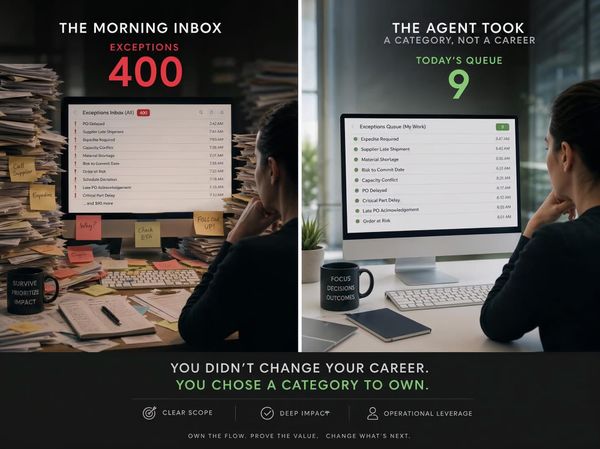
One Decision, Five Systems
Four systems gave four correct answers about one pallet. The fix wasn't better data. It was deciding who gets the last word, and then telling the person who used to have it.
Twenty minutes she owned
For eleven years, the 8:15 call has been where Priya earns her title.
She runs distribution for the Southeast region. Every weekday the same voices dial in. Planning wants the promotion stock protected. Transport wants trailers full before the 2 p.m. cut-off. Customer service has an account escalating by Friday. Somewhere inside those twenty minutes, Priya decides who gets the dock doors and who waits.
Nobody gave her that authority in writing. She took it because someone had to. Over a decade, the friction between functions became the place her judgment lived, and the reason her phone lights up at 5 a.m. when a shipment misses a connection. She is calculating before her feet hit the floor. Her VP calls her the best firefighter in the network. She has never once thought of that as a problem.
The Thursday pallet
Then came the pallet.
Customer service had promised it to a mid-sized grocery account for Thursday. At five that morning the warehouse released a pick wave that allocated it to a replenishment order for a bigger customer. By ten, the account manager was apologizing, the DC supervisor was defending the wave, and the demand planner was explaining that the stock had been pegged to next week's promotion all along.
Priya pulled every screen onto the call. Each one proved its owner right.
The ERP showed the pallet available because nothing had been invoiced against it. The warehouse system meant something else by available: pickable, not quarantined, not already in a released wave. Planning meant projected available after the promotion it was protecting. Order management meant what it could promise. The transport system didn't count units at all, only the Thursday truck it had booked on the strength of the original promise.
One word. Five systems. Five honest answers.
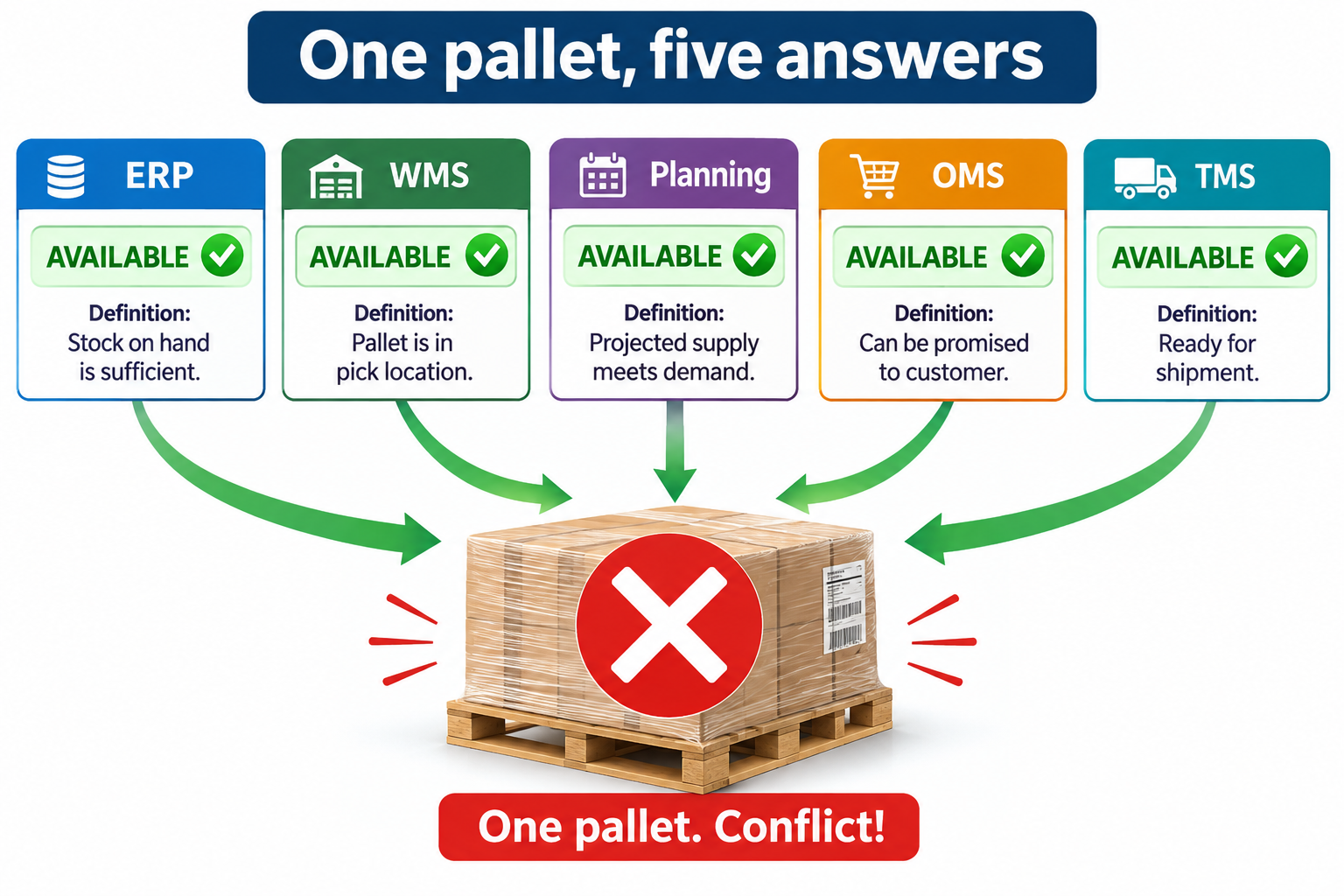
What stayed with her afterward wasn't the miss. It was the arithmetic. One decision, who gets this pallet, had been made five times, in five systems, by people who never spoke until it broke. Each system optimized itself. None of them optimized the chain. The hours it took to reconcile them, the decision latency, were the real cost of the morning.
A problem with two noons
The IT steering committee did what steering committees do. It called this a data problem and scoped an integration project.
Priya had sat through three of those. The data moved fine. What nobody had settled was which system gets the final say on one unit of stock when four of them want it.
The railroads hit that wall in the 1880s. Towns set noon by their own sun; the Chicago Public Library's history counts more than 100 local times in use. The clocks were accurate. The trouble was that nobody had authority over what time it was, and in 1853 two trains met head-on in Rhode Island because their crews were keeping different time. On November 18, 1883, the "Day of Two Noons," the railroads agreed who got to say what time it was. Congress didn't make it law until the Standard Time Act of March 1918. The railroads didn't wait for a better clock. They settled decision rights.
Most silos are decision-rights problems wearing a data costume.
Bain's Paul Rogers and Marcia Blenko found the same pattern inside companies two decades ago ("Who Has the D?", Harvard Business Review, January 2006). Decisions stall at the seams, function versus function. In one carmaker they studied, marketing believed it held the decision and product development believed it did, so in practice neither did. Swap marketing for the WMS and you have Priya's Thursday.
There was a harder lesson. The committee wanted a sharper forecast so the pallet wouldn't get double-promised. No forecast predicts a 5 a.m. wave release. In a volatile network you cannot forecast your way out of disruption. The speed of your second-best decision matters more than the precision of your first.
Settling the word, then the owner
The rebuild started small, on one decision: allocating constrained stock.
First the team settled the word. One shared definition of available, committed and promised now sits in a single layer, and each system's meaning maps onto it, so an agent reading the warehouse and the ERP knows it's comparing like with like. Nobody forced five systems to agree. They made the translation explicit.
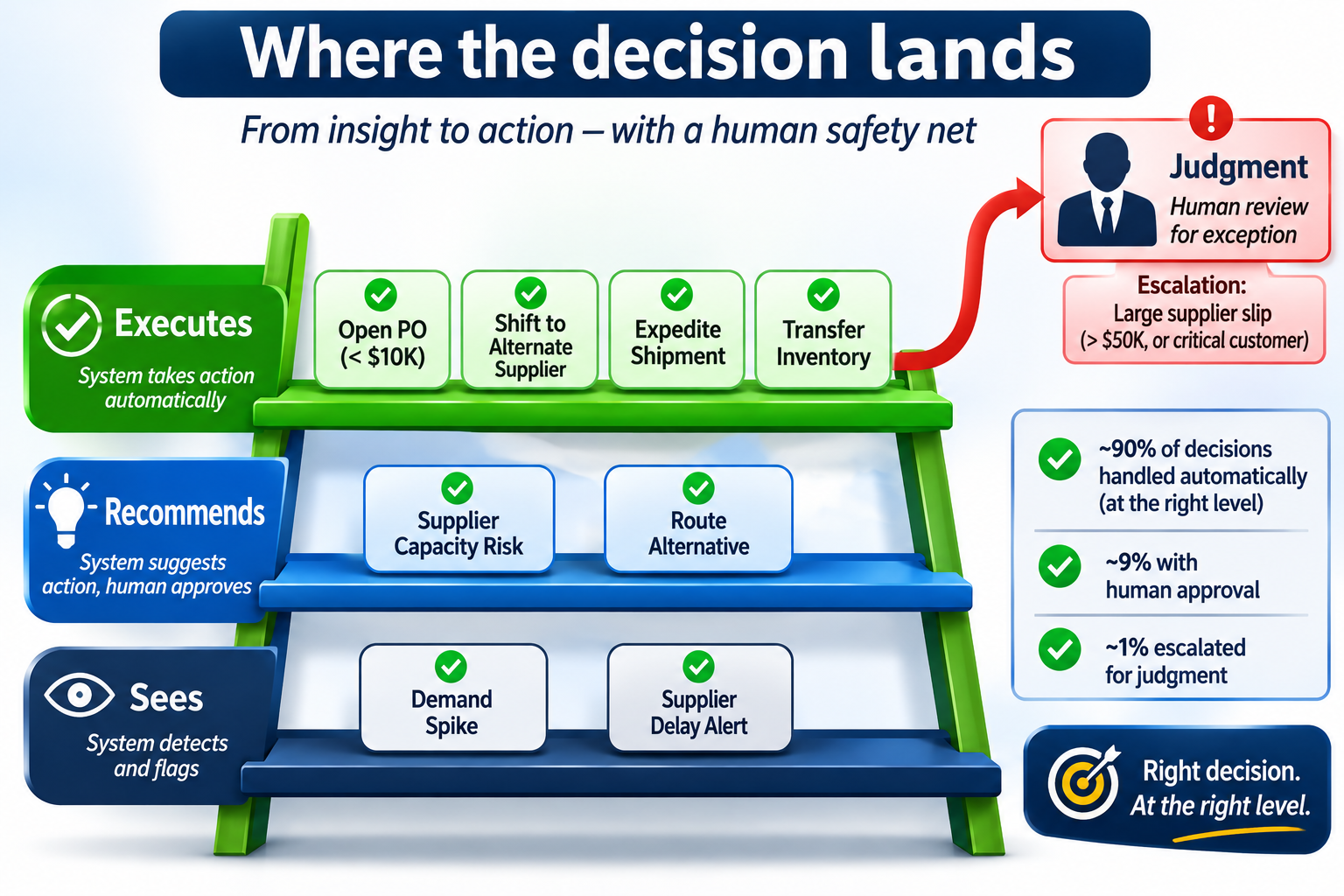
Then they settled the owner. Allocation got one. Carrier selection got another. The promise date got a third. Each decision sits on a rung where the system either sees, recommends or executes alone, with bounds on what it may do without asking. When something changes, systems publish the event immediately instead of waiting for the overnight batch. The owner acts. Everyone else holds a copy.
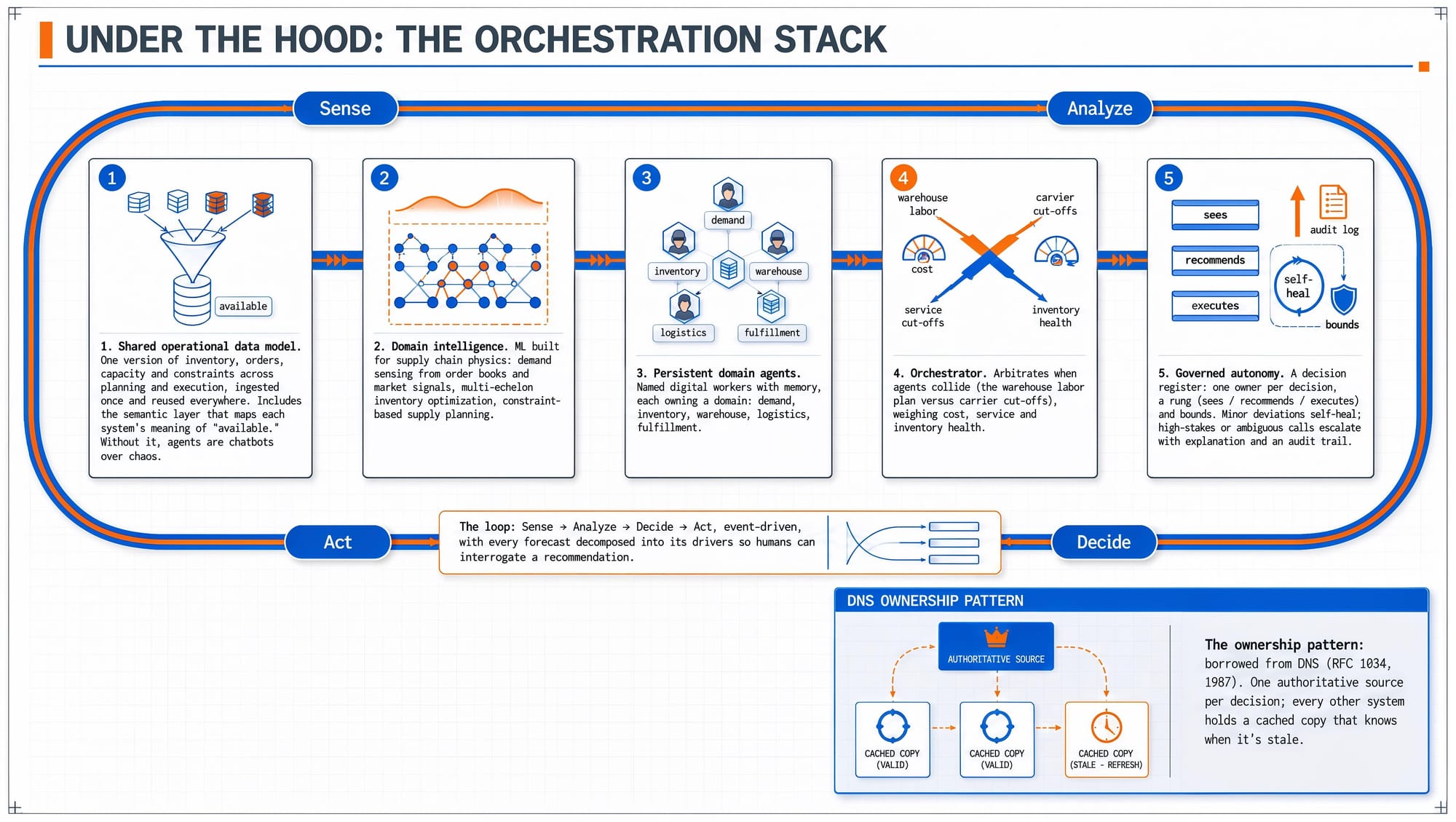
Gartner expects that by 2030, half of cross-functional supply chain management solutions will use intelligent agents to execute decisions autonomously (press release, May 21, 2025). Most of what gets sold under that banner today is a smarter alert sitting on the same fragmented stack: firefighting with better lighting. What Priya's team built wasn't a bigger dashboard. It was a different architecture.
The week the call got shorter
In the first month, the 8:15 call shrank to ten minutes. Then to the three cases the rules couldn't reach.
The demand planner who used to flip between five screens to find out why was relieved. Priya was quieter about it.
The test came in week six. A packaging supplier slipped a week on a fast-moving SKU heading into a holiday promotion. In the old world that meant the 5 a.m. text, a war room by nine, and four functions making their own version of the same call over three days of email.
This time the text never came. By the time she logged on, the allocation agent had re-pegged inventory across two DCs, transport had moved a Thursday booking to Friday inside its approved cost band, and order management had re-promised eleven orders with dates that held. One decision, propagated everywhere at once.
One case was waiting for her. Two strategic accounts, not enough stock for both, and a margin trade-off outside the agent's bounds. It arrived with the drivers laid out: what each choice did to service, cost and inventory health. She made the call in four minutes.
Then she sat with the question every good firefighter eventually asks. If the machine resolves the deviation, what am I for?
What she runs now
Escoffier's kitchens went through this. Station chefs had run their own clocks until the brigade moved the timing of every plate to the pass, where one voice called the orders. The good chefs kept their craft and gave up the when.
Priya's answer came from a conversation, not a release note. Before go-live, her director sat down with her and told her what she runs now: the rules themselves. Which decisions the agents may take alone, where the bounds sit, when the hard cases come to her. She owns the trade-offs that matter, like when cost is worth service and which account gets protected when everything can't be.
We've watched this land well and badly, and the difference was rarely the software. It was whether anyone had that conversation, and whether leadership made prevention visible. Nobody gets promoted for the disruption that didn't happen. So her director started reporting avoided disruptions next to fill rate, and told the story of the fire that never started in the quarterly review. McKinsey Global Institute estimates that disruptions lasting a month or more hit every 3.7 years on average and cost companies almost 45% of a year's profits over a decade. A boring quarter deserves a loud celebration.
Your best firefighters will grieve the hero role before they take up the conductor's baton. That's a leadership project, not a software install.
8:15, again
The call still starts at 8:15. Priya still runs it. It lasts as long as the hard cases need, and some mornings that's six minutes. She spends the rest of the hour tuning the bounds, loosening one where an agent has earned it and tightening another after a near miss.
Nobody asks anymore whose screen is right. They ask whether the rule was.
Whose authority in your organization lives in a meeting the new architecture is about to make shorter, and has anyone told them what they run next?
Sources cited
McKinsey Global Institute, August 2020. Month-plus disruptions every 3.7 years; almost 45% of a year's profits lost over a decade.
Gartner press release, May 21, 2025.
Paul Rogers & Marcia Blenko, Harvard Business Review, January 2006.
Bain & Company, 2006. Who has the "D"?
More than 100 local times; the Day of Two Noons; Standard Time Act, March 19, 1918.
1853 Rhode Island head-on collision attributed to crews keeping different time.
P. Mockapetris, IETF, November 1987.
Blue Yonder: domain agents, orchestrator and the Sense–Analyze–Decide–Act loop (sidebar). AI Agents for Supply Chain Software